
When comparing civil engineering firms North West project owners may find, it helps to look beyond technical capability. Unclear boundaries between Civils & Groundwork, Brickwork and Construction can make responsibilities, communication and later changes harder to manage. A clear plan for how the work connects is just as important as defining the tasks.
An integrated approach links these stages and gives each part of a project a clear place in the wider plan. This guide explains how Civils & Groundwork, Brickwork and Construction fit together, and what one-roof delivery can mean for coordination, project controls and day-to-day communication.
Based in Chester, Willmac Group delivers comprehensive, integrated, one-roof services, with a dedicated project manager and office support team for every project. Pricing is transparent, with no hidden costs. Any changes or additional expenses are discussed and agreed upon in writing before moving forward. The three-step process is Contact, Agree Work and Project Completed.
On a development, civil engineering covers infrastructure and site preparation that support construction and the completed project. The work can range from large-scale civil works to practical site preparation. Building work focuses on constructing the structure itself. These activities are distinct, but their scopes and sequence need to connect.
Civil engineering covers a broad range of disciplines, so the work depends on the development rather than following a standard package. For a project owner, the useful question is how site preparation and infrastructure relate to the planned build, and where responsibilities meet. When comparing civil engineering firms North West, consider the whole project and the interfaces between tasks, not just a list of services.
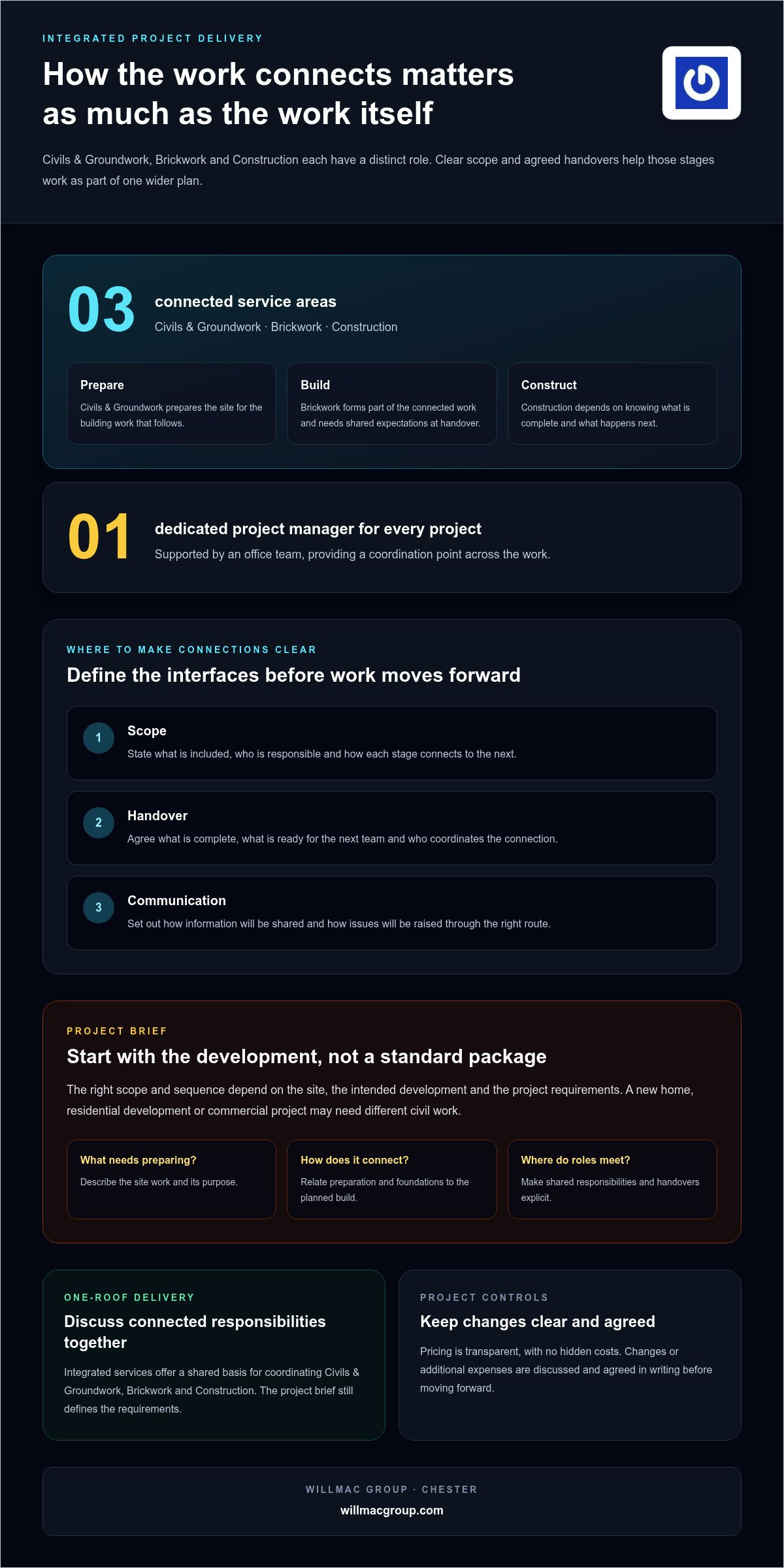
Civils & Groundwork prepares a site for the building work that follows. Site preparation and foundations need to align with the project requirements and the next stage of construction. If the handover is unclear, teams may have different expectations about what is ready and what happens next. Agreeing the scope early helps everyone understand what is included, who is responsible and how one stage connects to another.
The relationship between these stages varies with the site, scope and intended development. A new home, a group of residential properties and a commercial project will not necessarily need the same sequence or level of civil work. The project brief is the starting point for defining what is needed and how the work fits together.
Residential and commercial developers may need civil engineering input to prepare a site for new construction. Self-builders and people planning bespoke homes also need to understand how site work relates to foundations and the build. In each case, requirements follow the project brief rather than a one-size-fits-all checklist.
Public-sector developments and large-scale civil projects can involve infrastructure alongside building work. Willmac Group works on residential development, commercial projects and large-scale civil works, as well as projects for self-builders and bespoke home owners. Its Brickwork at Seren Lodge, a single-storey building at the Countess of Chester Hospital, is one example of specialist work within a wider development.
A useful first step is to describe the intended development and the site’s role in it. Be ready to explain what needs preparing, how it connects to the build and what the project brief should define. This makes the civil engineering scope easier to understand before work moves forward.
Work packages connect at their handovers. Civils & Groundwork, Brickwork and Construction each have a distinct role, but a decision or delay at the boundary between them can affect what another team is ready to do. It is not enough to identify the services required. The scope needs to show how they relate, who is responsible at each interface and how information will be shared.
For example, site preparation needs to align with the requirements of the next stage. Brickwork and wider construction also need a shared understanding of what is complete and what comes next. If responsibilities overlap, or a handover is assumed rather than agreed, uncertainty can arise over who should act. Setting out the connected scopes helps expose those points before they disrupt the work.
Site preparation is most effective when its purpose and connection to the rest of the build are clear. Include both in the project brief so the work can be discussed as part of the wider project.
Interfaces matter whenever one package’s output becomes another’s starting point. Agreeing who coordinates those connections helps teams share relevant information, understand what their scope includes and raise issues through the right route. Clear interfaces do not remove the need for project decisions. They give those decisions a defined point of reference across connected stages.
This clarity is useful whether a project has a few work packages or a wider set of responsibilities. Focus on shared expectations and agreed handovers, rather than assuming that every site needs the same sequence.
Willmac Group provides a comprehensive, integrated, one-roof service across Civils & Groundwork, Brickwork and Construction. Every project has a dedicated project manager, supported by an office team. This provides a coordination point for communication across the work and keeps questions connected to the wider scope.
Having these services under one roof gives clients a way to discuss connected responsibilities together, rather than treating each interface as an isolated conversation. The project brief still defines the requirements, while integrated delivery gives the team a shared basis for coordinating them.
When comparing civil engineering firms North West, consider how each firm will connect the work packages, not only which tasks it can undertake. A project discussion with Willmac Group’s integrated services team can bring the brief, responsibilities and coordination needs into one conversation.
Neither an integrated contractor nor separately managed work packages are automatically right for every development. The better fit depends on the project’s scope, how its stages connect and who will coordinate their interfaces. An integrated approach can bring related services into one agreed scope. Separate packages can also suit a project when responsibilities and communication between them are clearly organised.
A useful decision criterion is whether the project’s connected requirements can be covered within one agreed scope. Willmac Group delivers comprehensive, integrated, one-roof Construction, Brickwork and Civils & Groundwork services. This gives clients a clear basis for discussing how the work relates, without assuming every project needs the same package.
Consider the practical differences:
Where Civils & Groundwork, Brickwork and Construction are part of the agreed scope, integration can reduce the number of separate handovers a client needs to coordinate. A dedicated project manager provides a point of contact for connecting those work areas and discussing responsibilities. The scope and project decisions still need to be clear, but the coordination route is established.
Separate packages may suit a project where different contractors have distinct scopes. Set out what each package covers, where handovers occur and how questions will be communicated. Willmac Group’s pricing is transparent, with no hidden costs. Any changes or additional expenses are discussed and agreed upon in writing before moving forward. For wider context, see the commercial construction services guide.
As you compare civil engineering firms North West, assess the delivery model against the brief: which services need to connect, who will coordinate them and how responsibilities will be recorded. This keeps the decision grounded in the project rather than a general preference for one contracting structure.
Willmac Group’s dedicated project manager and office support team provide coordination across its agreed, integrated scope. To discuss how the services could fit your project, talk through an integrated project scope.
Clear project controls start with a shared understanding of what the development needs and what the agreed work covers. A project brief turns the initial idea into a defined scope: the intended outcome, the services involved, how responsibilities connect and how the client and project team will communicate. These points give discussions a practical focus and help prevent assumptions from replacing agreement.
Willmac Group’s process has three stages:
The sequence is straightforward, but the discussion matters. A well-understood brief gives both sides a reference point as the project moves forward.
In the early conversation, explain the project’s purpose, the work you expect to be included and any key connections between Civils & Groundwork, Brickwork and Construction. Discuss the main point of contact, how questions will be raised and how project information will be shared. This is not a prescribed document checklist. It is a practical way to make the scope and working expectations clear.
Every Willmac Group project has a dedicated project manager and office support team. Together, they provide coordination and communication points throughout the project. Clients know where to direct project discussions, rather than leaving responsibilities or queries unclear between connected work areas.
Project requirements can change as work is discussed or progresses. If a change affects the agreed scope or brings an additional expense, Willmac Group discusses it with the client and records the agreement in writing before moving forward. This gives both parties a clear reference for what has changed and what they have agreed to do next.
The client can understand a proposed change and agree to it before the additional work proceeds. A written agreement also keeps the project conversation aligned with the revised scope.
When comparing civil engineering firms North West, consider how each firm agrees scope and handles changes as well as the services it provides. To discuss your project requirements and agree a clear scope with Willmac Group, contact the team about your project.
Choosing a delivery partner is about more than matching a service to a task. For a project with connected site and building work, it helps to understand how the services are brought together, who coordinates them and how changes are handled. Based in Chester, Willmac Group provides comprehensive, integrated, one-roof Construction, Brickwork and Civils & Groundwork services for residential development, commercial projects and large-scale civil works.
This joined-up service gives clients a clear basis for discussing scope across related work areas. Every project has a dedicated project manager and office support team, providing practical points of coordination and communication. Any changes or additional expenses are discussed and agreed upon in writing before moving forward.
Willmac Group’s project examples cover different types of development. At the Countess of Chester Hospital, the work included Brickwork on Seren Lodge, a single-storey building. This is an example of the company’s Brickwork, not a claim that every service was involved in that project.
For Blueoak Estates, the work includes detached family homes and apartments. RSC’s projects include social apartments and residential housing schemes. These examples span individual buildings and housing developments, giving residential and commercial clients relevant context for discussing their own project requirements. Each new project is considered against its own brief.
The process follows a clear sequence. Contact begins the conversation about the project and its requirements. At Agree Work, the proposed scope and pricing are discussed and agreed. Project Completed is the final stage. This gives clients a straightforward route from an initial discussion to agreed work and completion.
Transparent pricing means no hidden costs. Any change or additional expense is discussed with you and agreed upon in writing before Willmac Group moves forward. This keeps the decision clear and gives both parties a shared record of what has been agreed.
For those comparing civil engineering firms North West, Willmac Group brings Civils & Groundwork, Brickwork and Construction together under one roof, supported by project management and office support. Discuss your project with Willmac Group.
Bring the project requirements into one focused conversation: what you are planning, which work needs to connect and what you need from a delivery partner. This gives you a practical starting point for discussing scope with civil engineering firms North West and deciding how the work should be organised.
Willmac Group’s comprehensive, integrated, one-roof approach brings Construction, Brickwork and Civils & Groundwork together, with a dedicated project manager and office support team for every project. Any changes or additional expenses are discussed and agreed upon in writing before moving forward.
Share your project brief and discuss how the work could fit together. Discuss your project with Willmac Group.
A civil engineering firm contributes site and infrastructure work that a development needs alongside its building work. The exact contribution depends on the brief. On a project with connected work areas, for example, site preparation needs to align with the construction that follows. Discussing those interfaces early helps define what is included and how it relates to the wider development.
Bring civil engineering into the scope discussion early, especially when site preparation and building work need to connect. Early conversations can identify which work areas belong in the brief and what information is needed to agree the scope. For a project in Chester, this helps clarify the intended development before decisions about connected work packages are settled.
Yes. Willmac Group provides comprehensive, integrated, one-roof Construction, Brickwork and Civils & Groundwork services. Clients can discuss connected work areas within one agreed project scope, with a dedicated project manager providing coordination. This can help when a new build involves linked site and building work, while the specific responsibilities still need to be defined for that project.
Civil engineering firms work within the responsibilities and communication arrangements set for a project. Make clear who is involved, what decisions each person handles and how information should be shared. Willmac Group provides a dedicated project manager and office support team for every project, giving clients clear points of contact and helping keep communication connected to the agreed scope.
Start with a plain-language outline of what you plan to build, where the project is based and what work you want to discuss. It also helps to explain the intended use of the development, the stage you have reached and any known site or scope considerations. A clear initial brief gives the conversation a useful starting point.
Any change or additional expense is discussed with the client and agreed upon in writing before moving forward. This gives both parties a clear record of the decision and distinguishes the revised work from the original agreed scope. Willmac Group’s If your requirements change, the proposed adjustment is discussed before it proceeds.
Yes. Willmac Group works on residential development and commercial projects, as well as large-scale civil works, self-builds and bespoke homes. Its Construction, Brickwork and Civils & Groundwork services are discussed in relation to each project’s brief, so the agreed scope reflects the development rather than assuming every client needs the same work. Willmac Group is based in Chester, UK.